How agent integrations get built inside large organisations
Registries, auth brokering, generated tool schemas and the org failure modes that stall internal agent platforms — grounded in public specs.
An internal agent needs access to the systems where the work happens. Connecting it to those systems means dealing with permissions, credentials and the teams that own them.
Each service has its own authentication, rate limits and data-access rules. Its owners also have their own priorities. Connecting fifty services means working through those differences fifty times unless the platform gives teams a shared way to handle them.
I would start with a shared registry and an auth broker. The public specifications below explain what each can handle and which decisions still belong to the organisation.
Why everyone builds a registry
An internal agent can start with a few hand-written HTTP calls. Someone writes a Python function that hits the ticketing API, pastes a bearer token into a config, and it works. The second and third teams do the same thing against the same API with different tokens, different retry logic and no shared record that any of it exists.
Once several teams do this, a registry gives them somewhere to answer four questions:
| Question | What the registry answers |
|---|---|
| What can an agent do here? | Discovery — one catalogue instead of tribal knowledge |
| Who authorised this call? | A single auth path per connector, not per caller |
| How do we turn it off? | One revocation point when a credential leaks |
| What did it touch last Tuesday? | Audit that spans agents, not per-team logs |
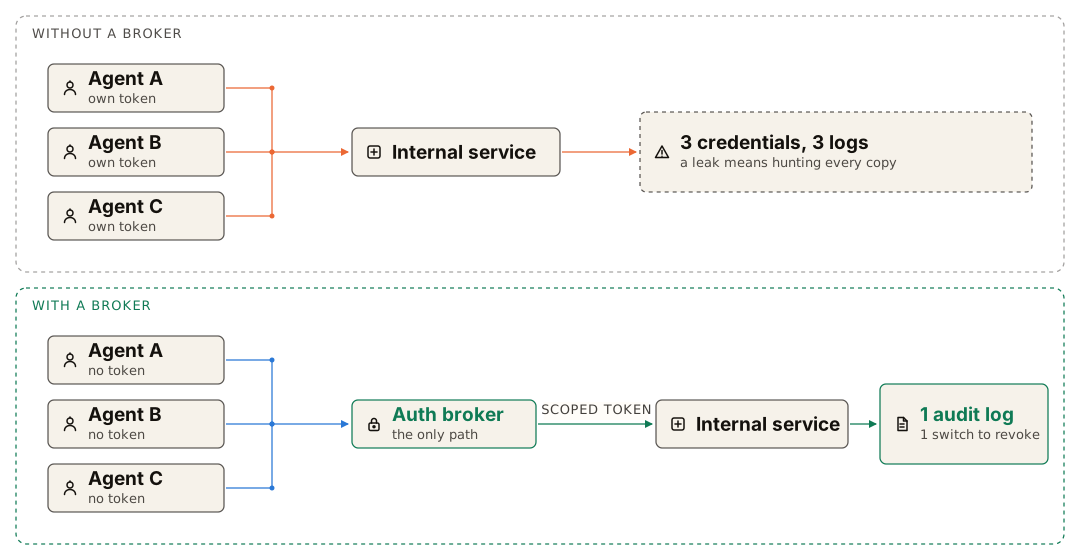
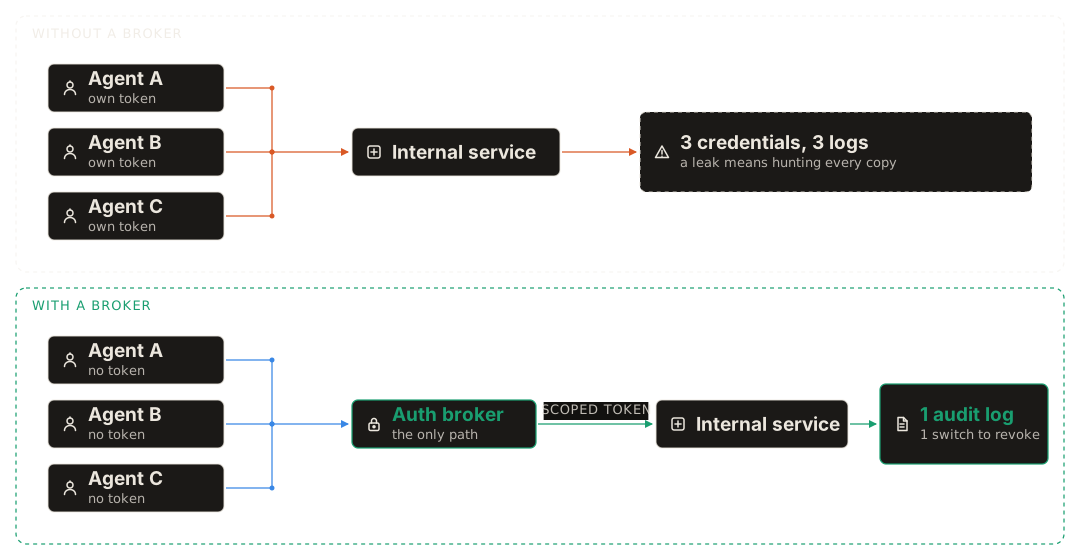
The prior art is not from the agent world. Backstage's software catalogue does this for services: teams commit a metadata YAML alongside the code, the catalogue harvests it, and the stated goal is that "no more orphan software" hides in dark corners of the org (Backstage docs). The service team owns its entry, and everyone searches the same index. I would use that split for an agent tool registry too.
MCP encodes the same split at the protocol level. A server declares a tools capability and answers tools/list; a client discovers what exists at connect time rather than at build time. Servers that declare listChanged push a notifications/tools/list_changed when the set changes, so the catalogue is live rather than a checked-in manifest (MCP tools spec).
The registry also needs an owner who keeps entries current. Otherwise teams will eventually stop trusting the catalogue and go back to asking around.
Whose permissions does the agent use?
I would settle this before building connectors. The choice affects every downstream permission check and audit log.
Service-to-service. The agent platform holds its own identity and calls downstream with its own credential. This suits work authorised for the service itself. For a user request, though, the shared identity can hide who asked and leave the platform responsible for enforcing that user's permissions.
On-behalf-of-user. The agent carries a credential scoped to the human who asked. Downstream permission checks work unchanged. Audit logs name a person. I would use this as the default for user-initiated work, even though it takes more integration effort.
The public app platforms model the distinction cleanly. Slack's OAuth v2 splits the request into scope (bot token, the app's own identity) and user_scope (user token, acting on behalf of a user), and you request both when you need both (Slack OAuth docs). GitHub Apps have three credentials for three situations: a JWT to authenticate as the app, an installation access token to act as the installation, and a user access token so the app "only takes actions that could be performed by a specific user" (GitHub docs).
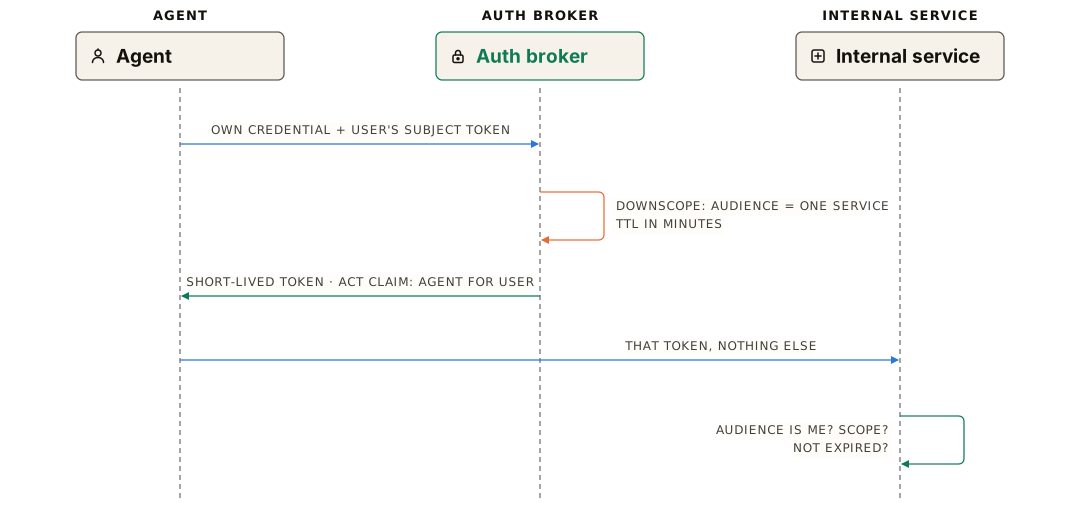
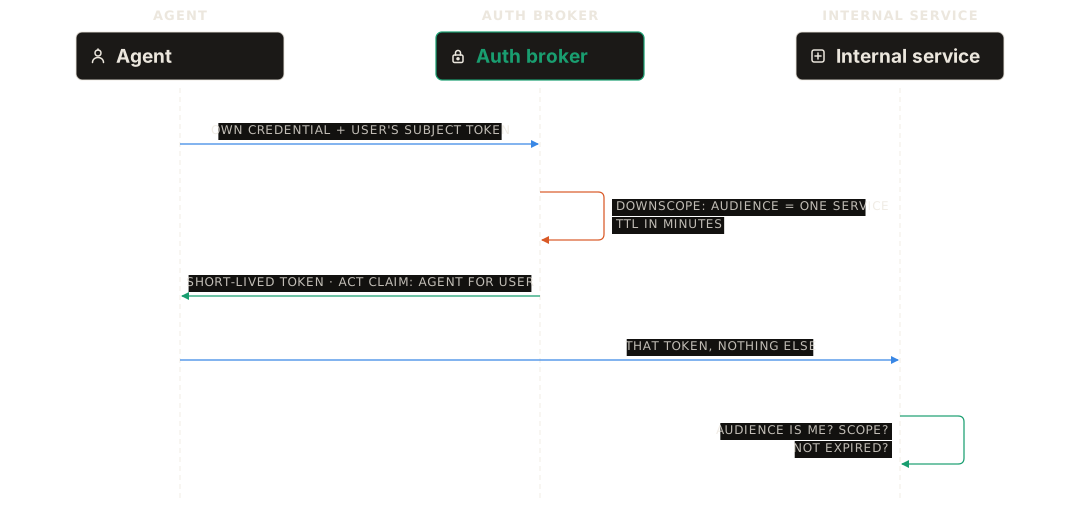
GitHub's installation token also demonstrates the two properties an internal broker needs. It expires after 1 hour, and when you mint one you can pass repositories and permissions to narrow it below what the app was granted (token generation docs). The broker can issue a short-lived credential with only the access needed for the request.
The mechanism for doing this generically is RFC 8693 token exchange. Grant type urn:ietf:params:oauth:grant-type:token-exchange, a subject_token for the user whose rights are being used, an optional actor_token for the thing doing the acting. The RFC's distinction between impersonation (the agent becomes indistinguishable from the user) and delegation (the agent keeps its own identity, expressed in an act claim, while carrying the user's rights) is the design decision, and delegation is the one you want. An audit trail that says "agent X acting for user Y" preserves both identities for an incident review. audience and scope on the exchange request are how you narrow per call.
The confused deputy, made worse
An agent reads text and then acts on it. That text can contain instructions. This turns a classic confused-deputy problem into a routine one.
MCP's security best practices document spells out the specific version: a proxy server with a static client ID to a third-party auth server, plus dynamic client registration, plus a consent cookie set on first authorisation, equals an attacker who can register a client with their own redirect_uri and have the auth server skip the consent screen entirely because the cookie is already there (MCP security best practices). Required mitigations: per-client consent stored server-side and checked before forwarding, exact-string redirect_uri matching with no wildcards, and single-use state values stored only after consent is approved.
The related rule is short enough to memorise. Token passthrough is forbidden. An MCP server "MUST NOT accept any tokens that were not explicitly issued for the MCP server," and if it calls an upstream API it must obtain a separate token rather than forwarding the one it received. The enforcement mechanism is RFC 8707 resource indicators: clients MUST send resource on authorisation and token requests, servers MUST validate they are the intended audience (MCP authorization spec).
If your internal broker forwards the caller's token to the downstream service unchanged, you have built the anti-pattern. A successful API call alone would not reveal that mistake.
Tool definitions are an interface contract
Hand-written tool schemas drift. The API adds a required field, the schema does not, and the agent starts failing in a way that looks like a model problem for the two days it takes anyone to check the spec.
Generate them. FastMCP's from_openapi() turns every endpoint in a spec into a tool by default, deriving names from operationId, with RouteMap rules that can mark internal or admin routes as EXCLUDE (FastMCP OpenAPI docs). Protobuf service definitions work the same way. Generating schemas from the API definition reduces drift, provided the generation step runs when the API changes.
Descriptions still need editorial attention. An API spec may describe an endpoint without explaining when an agent should choose it.
That field is prompt text. The model uses it to distinguish similar tools. Anthropic's guidance on this is blunt: "even small refinements to tool descriptions can yield dramatic improvements," and "too many tools or overlapping tools can also distract agents from pursuing efficient strategies" (Writing tools for agents). Namespacing under common prefixes is the recommended way to draw boundaries when there are many.
A generic example of a description doing real work:
{
  "name": "ticketing_search_issues",
  "description": "Search issues in the ticketing system by text query. Returns at most 25 results, newest first. Use this to FIND an issue when you only know words from its title or body. Do NOT use this to fetch a known issue by ID — use ticketing_get_issue, which is cheaper and returns full body text. This tool cannot see issues in restricted projects the calling user lacks read access to; those are silently omitted.",
  "inputSchema": {
    "type": "object",
    "properties": {
      "query":   { "type": "string", "description": "Free-text search terms. Not a query language; boolean operators are ignored." },
      "project": { "type": "string", "description": "Optional project key to restrict the search, e.g. PLAT." }
    },
    "required": ["query"]
  }
}
Three details in this example need more than a parameter schema: when not to use it, what the cheaper alternative is, and that results are silently filtered by the caller's permissions. All three are the difference between a working agent and a confusing one. Write them by hand, keep them next to the generator config, and diff them in review like code.
This also affects caching. Tool definitions sit first in the cacheable prefix (the order is tools, system, then messages) and modifying tool definitions "invalidates the entire cache" at every level (prompt caching docs). A registry that returns tools in nondeterministic order destroys the cache on every request. Sort the list. See prompt caching across harnesses for what that costs, and prefill vs decode for why a 40k-token tool prefix is a prefill bill you pay on every turn.
Shipping it
I would deploy a connector using the same process as other services: internal PaaS or a Kubernetes target, staged environments, a review gate before production credentials are issued. Kubernetes operators are the closest structural analogue for the runtime — a control loop reconciling declared connector state against what is actually registered.
Observability is where agent work differs from normal service work, and the three things you need are specific:
- A trace that spans the agent loop, not just individual HTTP calls. One trace ID from user turn through every tool call and back, or you cannot answer "why did it do that."
- Per-tool latency and error rate, broken out by tool name. Tool sprawl is invisible until you can see that eleven tools have never been called and three account for 90% of errors.
- Replayable transcripts. The full message list including tool schemas as they were at the time. Without the schema snapshot you cannot reproduce a failure after someone edits a description.
Where delivery gets stuck
The protocol leaves several organisational problems unresolved:
Data-owner sign-off has no SLA. Every connector touching user data needs approval from whoever owns that data. That review is unbudgeted, unqueued and unowned, so it takes as long as it takes. Fifteen connectors at three weeks each, serialised through one privacy reviewer, is your actual delivery date.
Nobody owns the registry. It gets built by whichever team needed it first, then that team reorgs. Entries rot. New teams route around it because the thing they need is not in it, which makes it less complete, which makes more teams route around it.
Tool sprawl. This one has numbers now. GitHub cut Copilot's default toolset to 13 core tools and grouped the rest into four virtual categories, reporting a 2–5 percentage point improvement in success rate on SWE-Lancer and SWE-bench Verified across GPT-5 and Sonnet 4.5, plus roughly 400ms lower response latency in online A/B testing (GitHub blog). A registry with 200 entries and no selection layer is worse than one with 15. Treat it as a context engineering problem, because that is what it is: filter to a task-relevant subset before the request, or accept the degradation.
The long tail has no API. A meaningful fraction of internal systems expose a web UI, a shared spreadsheet, or a nightly CSV drop. There is no clean connector for these. Someone will propose browser automation. Budget for it being flaky and scope it to read-only.
MCP's own scope-minimisation guidance names the pattern that makes all of this worse — publishing every possible scope in scopes_supported and using omnibus scopes like * or full-access, which drives consent abandonment and makes revocation disruptive. Start with a minimal read-only scope set and elevate on demand via WWW-Authenticate challenges.
What a shared protocol changes
It did not solve auth. The hard parts of auth are still hard, and the spec mostly points at OAuth 2.1, RFC 8707 and RFC 9728 rather than replacing them.
What it changed is the coupling. Before a standard protocol, an internal tool server was written against one agent framework, and moving to a different framework meant rewriting the integration layer. Now the server is written once and any client speaking the protocol consumes it — an IDE assistant, a chat surface, a CI job, a different vendor's model entirely. tools/list and tools/call are the whole contract for tools.
My read on why that matters organisationally rather than technically: it changes who has to say yes. The team that owns a service can stand up a server for their own data and put it in the registry, without the agent platform team writing a line of code and without a framework migration hanging over the decision. That lets service teams add integrations without waiting for the agent platform team to build each one.
Published 2 September 2026, last revised 23 September 2026. Revised in place rather than reposted — the date above is the one that matters.